



How do your employees view income protection today? A new AG survey of 1,000 Belgian workers reveals a striking shift. Belgians are increasingly aware that long-term absence can happen to anyone, and they are clearly looking to their employer for protection. If income protection is missing from the reward package, many employees are willing to dedicate part of their existing benefits budget to it. A clear sign that expectations around remuneration are changing.
74% expect to experience long-term absence at some point in their career
For many employees, long-term incapacity for work is no longer a distant possibility. 74% believe there is a real chance they will one day be absent for an extended period. Personal experience changes perceptions sharply: among those who have already been off work for more than a month, 81% consider a new period of incapacity realistic, compared with 67% among those who have never experienced it. Mental health-related causes stand out clearly and are now among the main reasons why employees fear a long-term absence.
The blind spot is not the risk. It is the income shock
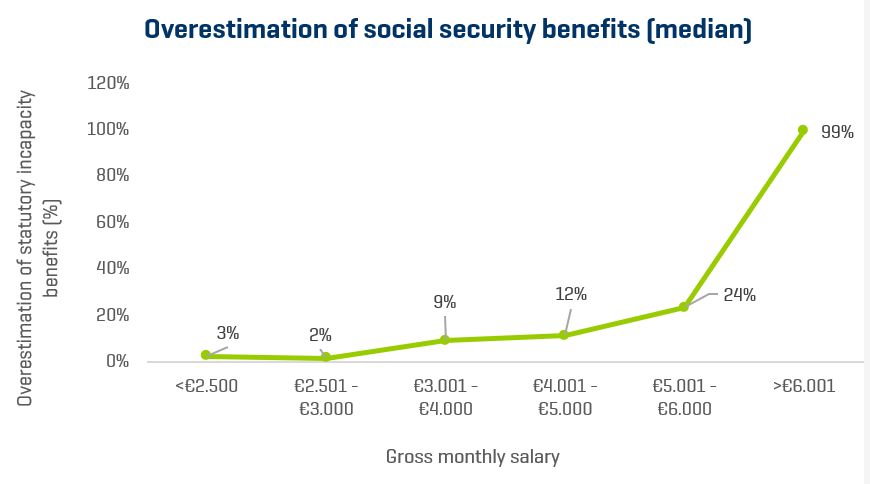
Awareness of the risk is growing. Yet the financial reality is still widely underestimated. Many respondents expect statutory benefits to be higher than the amount they would actually receive. For incapacity lasting less than one year, 55% expect a benefit above the social security ceiling. After one year, that figure rises to 61%.
The gap is particularly pronounced among higher earners. Employees with a gross monthly salary above €6,000 overestimate the statutory benefit by an average of 99%. In other words, they expect to receive almost twice as much as they would actually be entitled to.
Eight in ten are not prepared for the real loss of income
This gap between expectation and reality leaves employees especially vulnerable. 74% of respondents fear financial difficulties if they become unable to work. And 81% do not think they would be able to maintain their current standard of living. Employees who have income protection insurance through their employer, by contrast, are noticeably less worried. They are less likely to fear financial problems in the event of incapacity than employees without this protection.
Employees are looking to their employer for solutions
The survey also shows that employees are increasingly looking to their employer. Income protection insurance is no longer seen as a nice extra: 93% consider it essential, placing it on the same level as hospitalisation insurance. Even more tellingly, 1 in 2 respondents say that the absence of income protection could be a reason to turn down a job offer. Income protection is therefore not only a safeguard in the event of illness, but also a marker of responsible employment.
For employers, the opportunity is clear: offering income protection means responding to a concern that is now very real for many employees.
Want to respond to this growing expectation?
With Income Care by AG, you help cushion the loss of income employees may face during long-term incapacity for work. In addition to statutory benefits, they receive a supplementary disability annuity, helping to ease financial pressure so they can focus as much as possible on their recovery.
Employees are willing to allocate part of their benefits towards stronger income protection
But what if an employer does not yet offer this protection? Employees appear surprisingly willing to swap other benefits for greater income security. As many as 55% say they would be willing to allocate part of the budget currently associated with a company car to income protection insurance. Similar findings were recorded for cycle leasing (57%) and public transport benefits (52%). The message is clear: people expect a reward package that does more than motivate. They want one that protects them when it matters most.
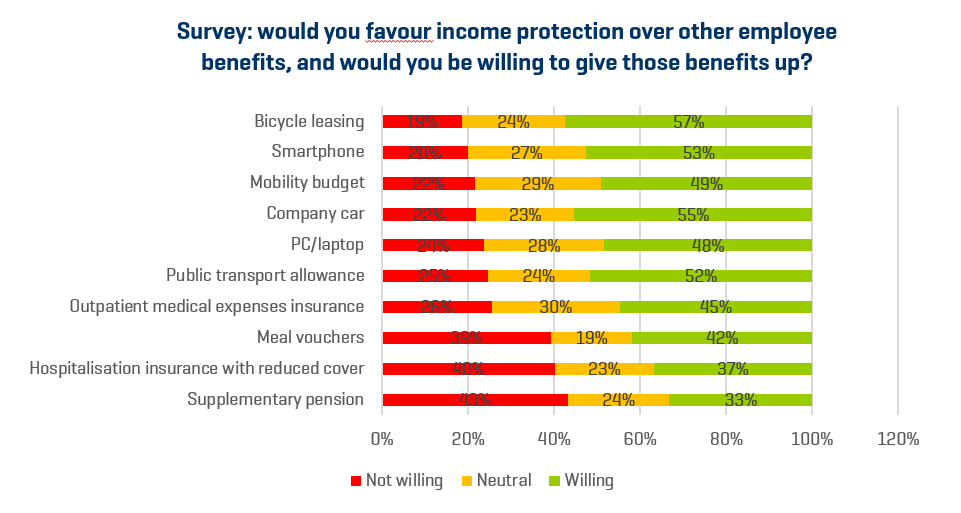

"Insurance that protects carries more weight than benefits that attract. Employees now value income protection more than a company car. A few years ago, that would have been almost unthinkable. But with long-term sickness at record levels and growing awareness that this risk can affect anyone, priorities are shifting. When someone is off work, they may miss their bicycle leasing or meal vouchers. But they will miss their income far more."
Benoit Halbart – Managing Director Employee Benefits & Health Care
Support beyond income is gaining ground
Income protection insurance offers financial security when an employee is absent for a long period. But expectations now go further. 86% say support when returning to work is important. At AG, we also see that a successful return requires more than replacement income alone. Employees often need tailored guidance, aligned with their situation and what is realistically possible.
Already have income protection insurance with AG?
Employees on long-term absence due to mental health-related issues can count on Return To Work by AG. This personalised guidance programme, included in the cover at no additional cost, supports them step by step towards a sustainable return. The results speak for themselves: nearly 7 in 10 participants return to work, more than 80% return to their original employer and in 9 out of 10 cases there is no relapse.
Conclusion
The survey results leave little room for doubt: employees’ expectations are changing. Income protection, well-being and support during recovery are becoming increasingly important. Income protection is evolving from a conventional fringe benefit into an essential part of the reward package.
Questions?
Please do not hesitate to contact your usual contact person. We will be happy to help.